
According to the U.S. Census Bureau’s most recent data, the Houston MSA population grew by 127,000 in 2025 to 7.9 million. The growth was down from 197,000 in 2024.
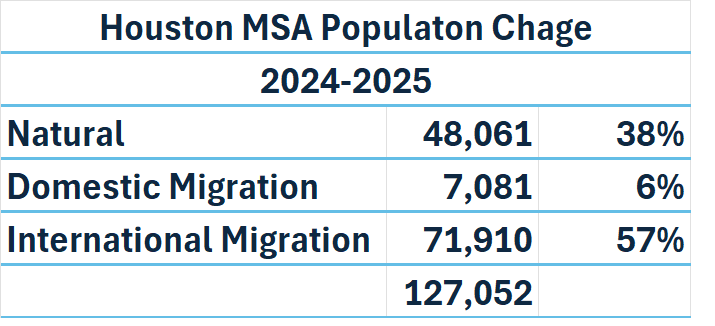
The region saw a 1.6% decline in natural growth (births minus deaths). Births rebounded slightly for the year (+1%), but fatalities rose by 3.2%. Nonetheless, the region’s natural population growth is somewhat of an outlier compared to other regions. About 40% of MSAs in the country had negative natural growth last year. Our region ranked third, trailing only New York-New Jersey and Dallas-Ft. Worth. This is largely due to having a younger demographic than most of the country, which has been fueled by large-scale international immigration.
Most of the decline in the region’s growth was due to a drop in international immigration (128,000→72,000). Still, the region received the third-highest influx of new residents from other countries, trailing only the New York-Jersey and Miami MSAs.
It is important to keep two things in mind regarding the Census Bureau’s estimate of international immigration. First, it is, by far, the most speculative number in their estimates. We simply do not have a good way to count the number of immigrants who enter or leave the country. That, in and of itself, speaks volumes about how dysfunctional our immigration system is.
The second important factor to keep in mind is that the Census estimates are as of July 1 every year. So, this estimate is as of July 1, 2025. Therefore, the estimate covers about seven months of the Biden administration and five months of the Trump administration. Given the Trump administration’s much more aggressive immigration enforcement policies, it is likely that the bulk of the immigration captured in this estimate occurred before the new administration took office. This suggests that next year’s estimate will likely be even lower – potentially much lower.
The number most likely to surprise you is that only a net of 7,308 new residents moved to the region last year from elsewhere in the U.S., i.e., net domestic migration. This ranked 39th among MSAs in the U.S. The Austin, San Antonio, and Dallas-Ft. Worth regions all had more than double our domestic migration.
Domestic migration within the region was sharply divided between Harris County and the rest of the region. Harris County lost 43,000 residents to domestic migration, while the other counties in the region gained 50,000 residents. What we do not know is how many of those new residents in the surrounding counties came from Harris County, though I suspect it was a large number.1
The bottom line is that the Houston region’s population growth is very dependent on international immigration. Therefore, federal immigration policy will have an outsized effect on the region’s future growth. This is true not only for net international immigration but also for natural growth. That is because for the last decade, 40% of births in Harris County (where nearly 70% of the region's births take place) were to mothers not born in the U.S. If the federal government continues to pursue very restrictive immigration policies, o we should expect our region’s population growth to be very tepid.
___________________________
Note 1 - You may notice that there is a 227 difference between this estimate of domestic migration for the region and the value in the table above. That is because the sum of all the counties in the Houston MSA in the Census' county estimates does not equal the number in the Census' MSA estimates. So far, I have been unable to determine the cause of the difference.
Note 2 – At our Readers Conference last week, I learned from Dr. Helen You, Texas’ Senior Demographer, that the U.S. Census Bureau uses IRS and Medicare data to calculate domestic migration. That is, if you change your address on your tax return from one state to another, the Census Bureau counts that in their domestic migration calculation. Same with Medicare. Therefore, the domestic migration estimate is likely very accurate.
.png)



.png)