
Texans hate property taxes. An August 2025 UT-Texas poll found that 85% of Texans thought further reducing property taxes was either extremely or very important, including 55% who said it was extremely important. More than half of Republicans, Democrats, and Independents said it was either “extremely” or “very’ important.
By 2023, voters' angst over property taxes was reaching a boiling point. In response, the Republican state leadership made reducing property taxes a priority for the 2023 legislative session. The result was a bipartisan bill – SB2. It passed the Texas Senate unanimously and the Texas House133-4. In the Senate, it was co-sponsored by Republican Paul Bettencourt and Democrat Carol Alvarado.
Fundamentally, the bill shifted a portion of school funding from local property taxes to state revenues. It accomplished this by increasing the school homestead exemption and requiring school districts to reduce their tax rates according to certain formulas (known as “compression”) and then replacing the lost property tax collections with state revenues. The impact varied based on taxpayers’ circumstances, but a typical Texas homeowner saw a reduction on the order of 25–30% in the school portion of their property-tax bill.
By the 2025 legislative session, primarily because of rising property values, the pressure was on to do more. The Legislature responded with another round of school property-tax relief. It increased the mandatory homestead exemption again and imposed additional tax-rate compression. As in 2023, the state assumed more of the cost of public education so that local school districts could collect less from property owners. These reforms also received widespread bipartisan support, and the final version passed both houses unanimously. A typical Texas homeowner saw an additional 15-20% reduction in their school tax bill as a result.
Of course, school property taxes are only a portion of a homeowner’s total property-tax bill, albeit the largest portion for most homeowners. So, when the State reduced the school-tax portion by about 35–40%, that translated into only about a 15–20% reduction in the overall property-tax bill, assuming—and this is important—the taxes imposed by the other local taxing entities remained unchanged. They did not.
To the contrary, many counties and cities saw an opportunity to raise their taxes, knowing it would be largely masked by the falling school taxes. From 2022 to 2025, the ten largest counties and cities in Texas increased their property tax levies by an average of 7.9% compounded annually, wiping out a large portion of the tax relief the Legislature had provided.
Now, at this point, you may be asking, " But wait, I thought local taxing entities are prohibited from increasing taxes by more than 3.5% without getting voter approval.” Indeed, in 2019, the Legislature passed a law to that effect. However, that law is riddled with exceptions to the 3.5% limit. As a result, it has little effect in restraining local entities from raising taxes to the supposed 3.5% cap. (More on that later.)
One of the local entities that jumped on this property-tax-raising bandwagon with gusto was Harris County. From 2023-2026, Harris County raised the average homeowner’s county taxes by 41%, wiping out a large portion--and in some cases--even all of the relief from the State.
However, the effect on individual homeowners has varied widely depending on which school district they lived in, what exemptions they had, and how quickly the value of their home was rising. So, we designed a model that would allow us to calculate the components of change for any homeowner’s property.
I have picked two homes to illustrate what has happened in Harris County. These are both actual homes, and the numbers are taken from their five-year property tax histories that are included each year on the tax bill.
The first is a home in the Cy-Fair School District. I picked this one because it is very close to the average home value touted by County officials. As you can see, the relief provided by the 2023 and 2025 bills reduced this homeowner’s Cy-Fair taxes by $1,016. However, their total bill only fell by $260 because Harris County scooped up $750 of that savings.
.png)
The next is a far more extreme case for a homeowner living in Garden Oaks. In this case, the 2023/2025 State bills reduced the homeowner’s bill by $877. But the Harris County increases more than wiped out that savings, plus some, by rising by $1,026—a whopping 51%.
Note that the tax bill for the other entities that tax this property also went up by $412. There were only small changes to the tax rates for these entities; in fact, the City of Houston lowered its rate in 2023. The increase in the tax bills for these entities was driven by the fact that appraised values have been rising rapidly in that area of the City. This underscores that the 41% increase in County taxes was for the average home, with a 2% increase in its appraised value this year. Many homeowners saw larger appraisal increases.
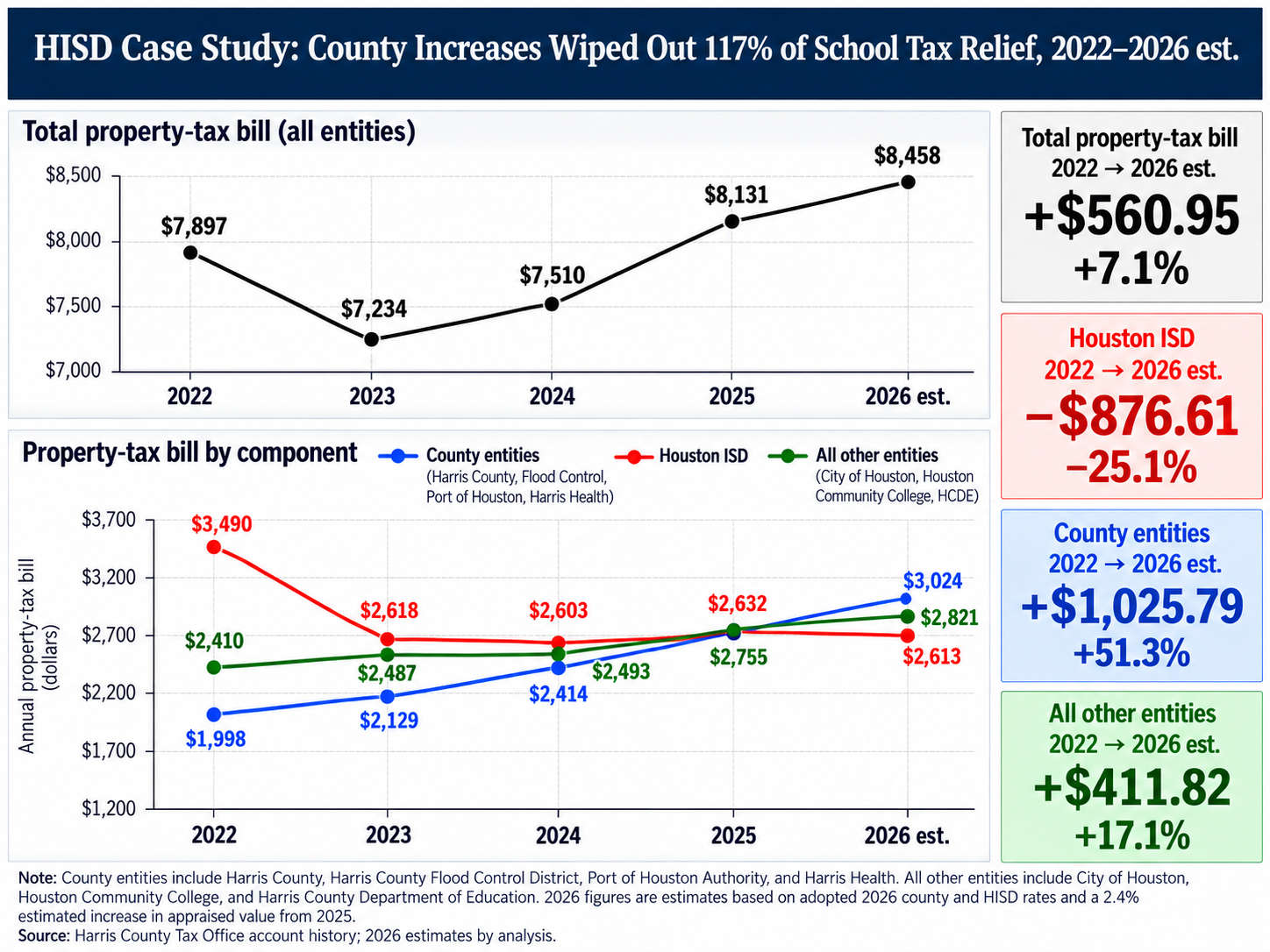
From these examples, you can see why many taxpayers feel like they have received little tax relief—because overall they have not. But the reason they have not lies squarely at the feet of local taxing entities—in our case, Harris County—for sopping up the bipartisan relief the Legislature passed in 2023 and 2025.



.png)